|
The terrestrial magnetopause is the boundary separating the plasma environment controlled by the Earth magnetic field from the plasma originating at the Sun and carried away by the solar wind. The problem of finding the macroscopic characteristics of space plasma discontinuities, in terms of their geometry (orientation, thickness, radius of curvature) and motion (velocity, acceleration), exists from the beginning on the scientific agenda of in-situ space exploration.
|
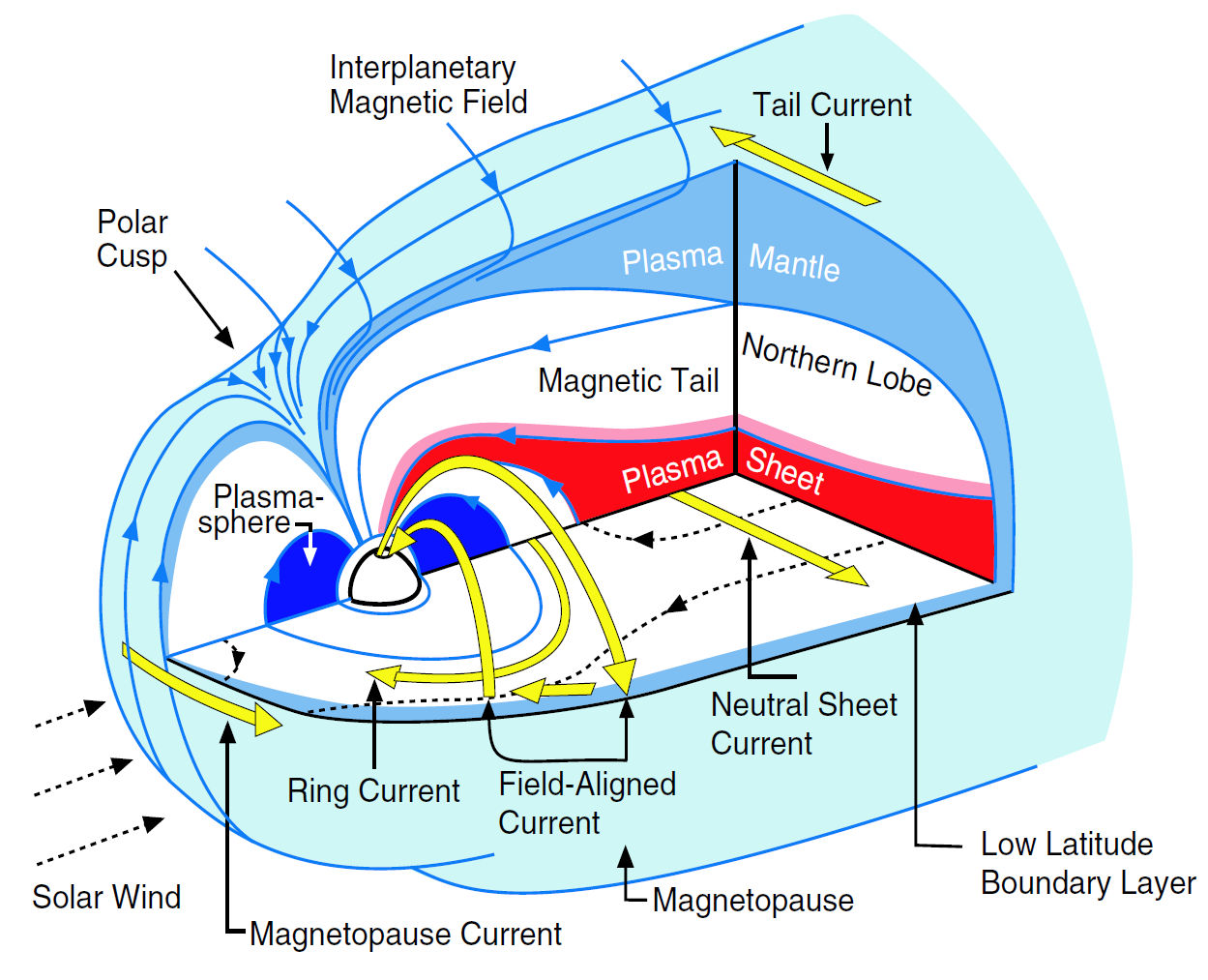
Three-dimensional model of the magnetoshere. The magnetopause and magnetopause boundary layer appear in light blue and darker blue, respectively. Different electric current systems are shown in yellow. Solar wind is coming from left. Credit to "Magnetopause and Boundary Layer", De Keyser et al., 2005
.
|
In his PhD work, the project leader developed a new method to estimate the macroscopic characteristics of a space plasma discontinuity, applicable when the layer acquires a 2-D, non-planar shape. The technique is meant to be used when four points of observation are available, as in the case of European Space Agency's Cluster mission. Through the ESTEEM project, the method will be further developed and its capabilities will be thoroughly tested on several magnetopause crossing events by Cluster. The method will provide a more detailed picture of the magnetopause dynamics, being able to estimate the parameters of the large scale amplitude waves that are often traveling on that surface.
The project team is formed by Dr. Adrian Blagau (project leader) and Dr. Octav Marghitu (mentor)
The project ESTEEM is financed by a grant of the Romanian ministry of Education, CNCS-UEFISCDI, project code PN-II-RU-PD-2012-3-0508, contract number 12/25.04.2013.
|